
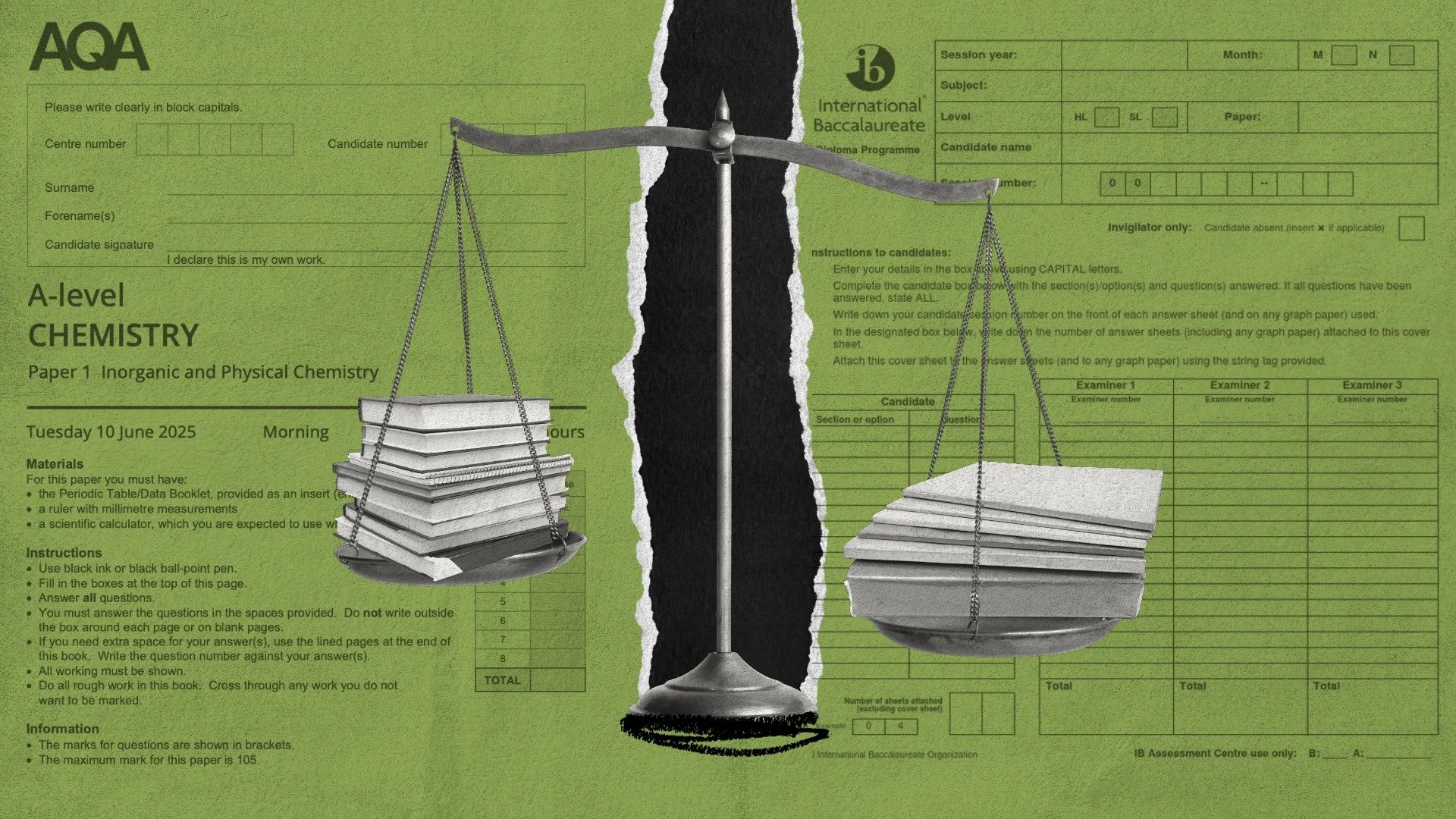
With school open evenings, subject choices and opinions coming from every direction, few decisions feel quite as weighty as the choice between A Levels and the International Baccalaureate (IB). Both are rigorous and are globally respected.
However, they offer a different experience and the decision of which one to choose depends more on the child and where they want to go next, rather than the prestige of the qualification itself.
The big picture argument
Sixth form is an unusual and formative bridge: students are narrowing down subject choices, with one foot still in school and the other already stepping towards the future. This two year stretch not only shapes how students think and see the world in the present, but also lay foundations for the choices (academic, professional, personal) that will shape their future years.
The A-Level route rewards depth of subject knowledge and theory. It allows a student to specialise early and to choose the 3 (often 4) subjects that interest and excite you the most. It’s worth noting that for some students, narrowing down to 3 / 4 subjects can bring quite a pressurising choice.
The IB Diploma rewards breadth of subject area. It allows students to keep a wide range of subjects going, keeping more options open for their future. This approach is praised by many who sit the exams, as they feel they aren’t cancelling out any future option before they get there. Alongside their six subjects, every student completes ‘Theory of Knowledge’, write an extended essay as well as taking part in CAS (contributing activities and services beyond the classroom).
Neither is ‘harder’ nor more respected.
The structural differences
Parents often want to see a breakdown of the difference. By way of summary:
Breadth vs Specialisation
A Levels usually involve studying subjects in depth. The IB requires six subjects - across languages, humanities, sciences and mathematics - as well as its core components.Assessment Style
A Levels are mainly assessed through final examinations at the end of two years and some coursework. The IB combines final exams with internal assessments and extended essays over the two years. You can choose to sit the Higher Level or Standard Level courses, with the higher level involving a greater deal more teaching hours and study.Independent Research
The IB’s Extended Essay is a serious academic project (4,000 words) and a great practice for university-style research.
A Level students may complete an EPQ (Extended Project Qualification), but it is optional rather than embedded.Global Recognition
Both are well recognised by UK universities. The IB, however, carries particularly weight with international universities, as its structure is more closely aligned with schools that promote interdisciplinary learning (like many of the US Colleges).
How do I know which one is best for my child?
For the student who thrives on depth of understanding, has a strong idea of where they’d like to go next and enjoys going deep in subject knowledge and theory – three A-levels provides the perfect space to specialise and build real subject confidence.
For more of an intellectually curious generalist, the IB offers breadth, structure and a more interdisciplinary organisation. It can help the student who still has choices to make about their future and helps to avoid them from narrowing down choices too early.
The right choice often comes down to a few idiosyncrasies of your child:
Do they prefer depth or variety?
Do they do well under high stakes exam pressure or a steadier set of assessments and coursework?
Are they certain about their next steps / future of learning, or are they still exploring options?
University admissions: what do they really think?
UK universities are clear: they value both pathways.
At highly competitive institutions such as London School of Economics and the Universities of Oxford and Cambridge, the most important outcome is academic excellence in any relevant subject. An aspiring engineer taking A Levels in Maths, Further Maths and Physics shows a university they are purpose driven. Likewise, an IB student achieving 7s in Higher Level Maths and Physics is showing the same.
For US universities, the broader nature of the IB can naturally align with their more holistic approach around critical thinking and the ability to study across multiple disciplines and subjects.
An important and reassuring reminder: university admissions teams are not choosing qualifications; they are choosing students!
Which should you choose?
A-levels will suit the student who:
Has a clear sense of what they want to study beyond school (Medicine, Engineering, Classics).
Enjoy depth of subject knowledge, over breadth.
Thrive under exam pressure and value a more structured, detailed programme.
The IB often suits students who:
Enjoys subject variety and interdisciplinary learning.
Have thoughts to go and study internationally.
Enjoys coursework and can manage multiple deadlines well.
Does not want to specialise too early on in their academic career.
Remember, the aim is not to choose the most impressive route (there isn’t one), but instead, to choose the structure in which your child is more likely to thrive in. Speak to one of our A-level or IB specialists who can help identify which path is the best route forward. Through personalised guidance, our team of mentors can help navigate your child’s subject choices and help build academic and personal confidence in their chosen pathway.