
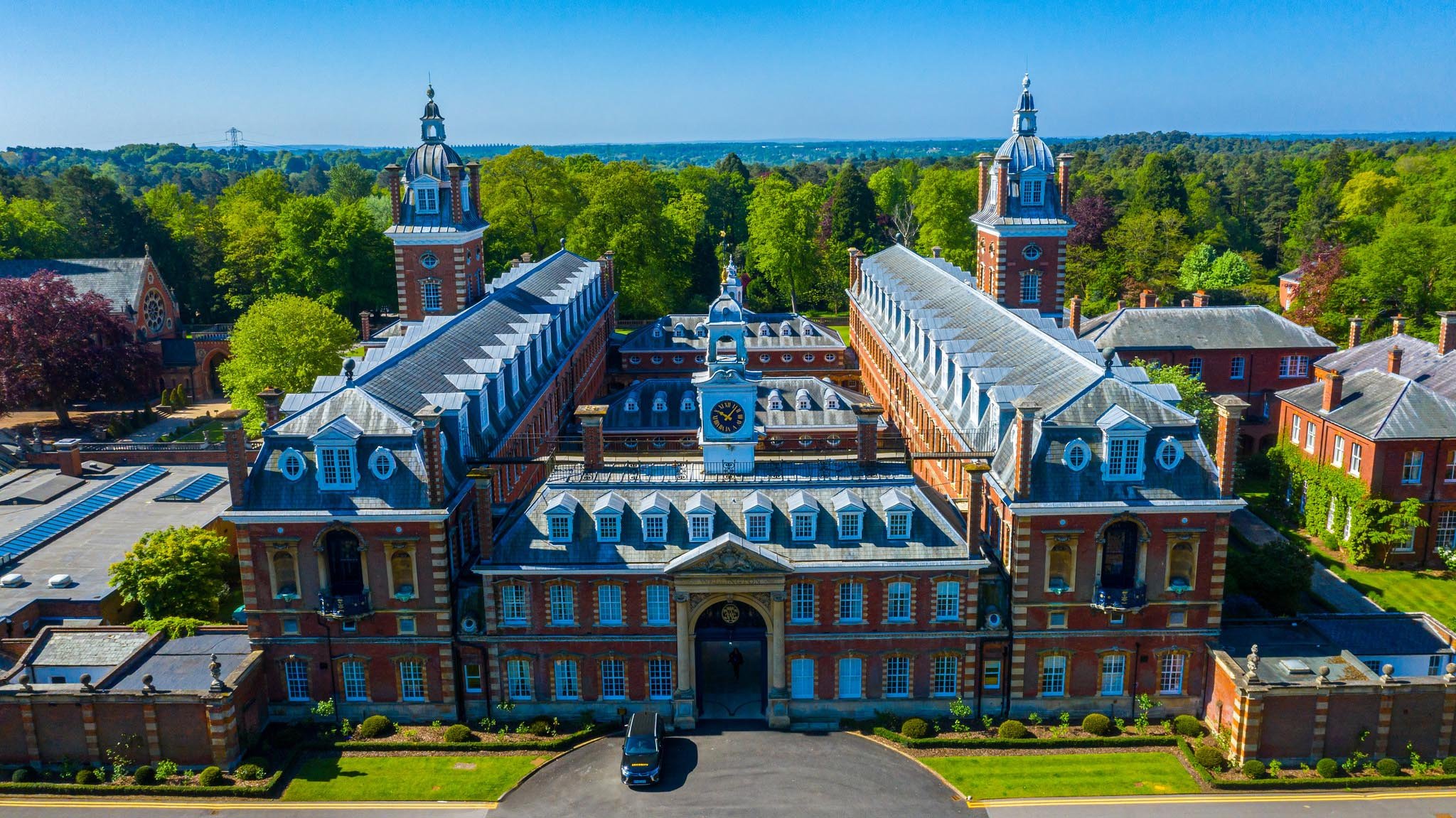
Wellington College is one of the world's leading co-educational boarding schools – academically demanding, character-driven and built around the idea that real education shapes the whole person.
Founded in 1853 by Queen Victoria as a national memorial to the Duke of Wellington, the school sits on a 400-acre parkland campus in Crowthorne, Berkshire, about an hour from central London and 40 minutes from Heathrow. Today it educates around 1,175 boys and girls aged 13 to 18, with an even 50:50 gender split. Around 80% board; the remaining 20% are day pupils drawn largely from the South-East. The 15th Master is James Dahl, and the school is built around five explicit College values: Kindness, Courage, Respect, Integrity and Responsibility.
The school's admissions process has evolved meaningfully in recent years – Wellington became fully co-educational well ahead of its peers, the application timeline is earlier than many parents realise and the financial-aid landscape now includes the Prince Albert Foundation Scholarship programme, one of the most generous widening-access schemes at any UK boarding school. This guide explains how each entry point works, what the school is genuinely looking for and what families need to know about fees, scholarships and timing. If you'd like to understand more about our approach to senior school admissions, you can explore our school search and placement service at any point.
How many pupils does Wellington take?
Every year, around 260 new pupils join Wellington at one of three main entry points:
Around 200 enter Third Form (Year 9) at 13+
Around 20 enter Fourth Form (Year 10) at 14+
Around 60 enter the Sixth Form (Year 12) at 16+
It is rare for pupils to join Wellington at any other stage, given the disruption involved in moving school mid-GCSE, A Level or IB Diploma. Most 13+ joiners come from UK prep schools – over 100 feeder prep schools are represented in the current pupil body – with a meaningful minority joining from UK state schools and international backgrounds.
The admissions process at 13+
The 13+ selection process is conducted in two stages and runs to a very specific timeline. The registration deadline alone is the most common reason families fall behind, so it pays to know it well in advance.
Registration
The closing date for Year 6 assessment is 30 June of Year 5. Wellington strongly recommends registering as early as possible, partly because the school operates a competitive intake and partly because the date of registration is a factor in House allocation (early registration improves the likelihood of a first-choice House). The registration fee is £400, non-refundable (the figure shown on Wellington's current online registration form; older guides may cite £360 or £300). The fee is waived for families applying for substantial fee assistance (greater than 90%).
For families undecided between boarding and day, Wellington recommends registering for a boarding place: it is difficult for the school to move a day pupil into boarding once they have arrived, but straightforward to switch from boarding to day.
Stage 1: ISEB Common Pre-Test
Children sit the ISEB Common Pre-Test in either Year 6 or Year 7, depending on when they registered. The Pre-Test is an online, age-standardised, adaptive assessment in English, Maths, Verbal Reasoning and Non-Verbal Reasoning, usually taken at the child's current school. Overseas candidates take it with the British Council or an approved test centre. Wellington also requests a headteacher's reference at this stage.
Stage 2: Assessment day at Wellington
On the basis of the Pre-Test results and the headteacher's reference, approximately 500 children are invited to a half-day assessment at Wellington, taking place in January or February of Year 6. This is deliberately not a further written test – it is a series of collaborative lessons and problem-solving activities, designed to give Wellington a feel for how each child engages with academic work and with their peers. There is also an interview with a senior member of pastoral staff, which Wellington conducts online via Microsoft Teams on a separate day. Overseas candidates unable to travel to the College are offered an additional virtual interview that is more academic in nature. The school describes its approach as a "whole child" assessment: the day is designed to give Wellington a feel for how a child thinks, contributes, listens and behaves around their peers.
Offers and the deposit
Conditional offers are made in March of Year 6. To secure the place, families pay a deposit by the end of June of Year 6. This means most successful candidates secure their Wellington place more than two years before they actually join. The long gap between offer and entry is intentional – it allows families to plan and lets Wellington allocate Houses with care.
Common Entrance and Wellington
This is one of the most common questions parents ask. Wellington's admissions process is decided in Year 6 through the ISEB Pre-Test, the assessment day and the interview, and the school's conditional offer is then confirmed solely on the basis of a positive reference of performance and behaviour from the candidate's current school at the end of Year 8. Wellington does not use Common Entrance as a qualifying exam for the place.
That doesn't mean Wellington-bound children skip Common Entrance entirely. Many prep schools still require their pupils to sit Common Entrance in Year 8 as their standard exit assessment, regardless of which senior school the pupil is going to – so CE preparation often remains part of the Year 7 and Year 8 timetable for prep-school pupils whether or not Wellington itself requires it.
Late admissions
Families who miss the Year 5 deadline have late assessment options in both Year 7 and Year 8:
Year 7 route: Children registered by 30 June of Year 6 follow Stages 1 and 2 above, 12 months later than the standard route. Assessment days take place in March of Year 7. House choices are more limited.
Year 8 route: Families applying after June of Year 7 may be invited to participate in an admissions process determined by Wellington at the time. The standard ISEB Pre-Test may not be required at this stage – Wellington can accept late entries without it in exceptional circumstances, but only if requested by the headteacher of the candidate's current school.
The admissions process at 14+
Wellington offers a small number of places to enter Fourth Form (Year 10) before the start of GCSE courses. The registration window runs from June to October, one year in advance of entry. Around 20 places are offered each year, weighted in favour of girls (most join Hardinge, Wellington's 14-18 girls' house). New 14+ pupils join an existing year group of around 190 girls and boys.
The 14+ assessment runs in three stages. Applicants first upload school reports and a personal statement at the time of registration. In mid-November, pupils complete a series of short online exams – known by Wellington as Quest tests – in Maths, Reading Comprehension, Verbal Reasoning and Non-Verbal Reasoning, sat at home. Shortlisted candidates are invited to a pastoral interview conducted online via Microsoft Teams, and an assessment afternoon at Wellington in January, similar in style to the 13+ assessment. School references are requested from current schools in early December (so candidates need to tell their current school they are sitting Wellington's entry tests). Offers are made after this process.
The admissions process at 16+ (Sixth Form)
Wellington's Sixth Form intake is one of the most internationally diverse at any UK boarding school – around half of new joiners come from a range of UK schools, the other half from international contexts worldwide. Approximately 60 new Sixth Form students join each year, both boarding and day. New joiners enter an existing year group of around 200.
The registration window runs from June to September, one year in advance of entry. There are two distinct routes:
Full-fee route (which may include means-tested fee assistance of less than 90% of full fees)
Significant fee assistance route – 90% to 100% means-tested support, including the Prince Albert Foundation Scholarship programme
Wellington asks families to read the information carefully and select the appropriate route at registration.
16+ assessment process
Applicants upload their latest school reports with grade predictions and a personal statement (no template – the school is explicit that candidates "should present themselves in whichever way they see fit"). After registration, candidates are asked to select three subjects in which to be examined plus a main area of interest. Short online exams are sat at home in October of the year before entry. Cognitive ability tests are also completed digitally at home.
Shortlisted candidates are invited to a pastoral interview conducted virtually in early November, followed by an assessment day at Wellington in mid-November. Specialist academic interviews are available online for those unable to travel. Decisions are announced on 1 December, with subsequent places offered to those on the Waiting List up until September.
Wellington College fees 2025/26
Wellington's fees include VAT at the standard rate from 1 January 2025. The school chose to pass the full VAT cost on to parents, which produced an effective fee increase of around 20% from the prior year:
Boarding pupils: £20,750 per term inc. VAT – approximately £62,250 per year
Day pupils: £15,250 per term inc. VAT – approximately £45,750 per year
Additional charges apply for musical tuition (£36 to £39 per 40-minute lesson, inc. VAT where applicable), trips and certain co-curricular activities. The non-refundable £400 registration fee is payable on application.
Fees are reviewed annually by the Governors. Always check Wellington's official fees page for the current figures.
Scholarships, Prince Albert Scholarships and bursaries
Wellington offers several distinct routes to financial and recognition-based support. Parents often confuse them, so here's how each one works.
Scholarships at 13+
At 13+, Wellington offers Academic Scholarships and Exhibitions awarded before entry through examination and interview in Year 8 (candidates must be under 14 on 1 September of intended entry). Wellington's seven highest academic accolades, the named Scholarships, are awarded only at the end of Third Form, based on a pupil's first year at the school. Music Awards – Scholarships and Exhibitions – are decided through auditions and interviews at the end of January in Year 8. They entail free music tuition in two instruments, plus free composition and Alexander Technique lessons for Scholars. Choral Scholarships are also available, with sight-singing a prerequisite.
Scholarships for Art, Dance, Drama and Sport are not awarded before entry. Instead, Wellington runs "Inspire Days" in Year 8 – action-packed assessment days in each discipline that allow children with particular talent to show their potential to Wellington staff. Sport, Art, Dance and Drama Scholarships are then awarded at the end of Third Form, based on performance and potential during the first year at the school.
An important clarification: Wellington's scholarship awards do not, by themselves, provide a reduction in school fees. This is stated explicitly on the school's own pages. Scholarships at Wellington confer recognition, additional opportunities and (for Music Scholars) free tuition in additional instruments – but they are honorary in financial terms.
Scholarships at 16+
At 16+, Wellington offers Scholarships in Art, Dance, Drama, Music and Sport before entry. Every candidate is also automatically considered for an Academic Scholarship. Candidates can apply as part of their registration, but only those who reach Stage 3 are invited for scholarship assessment.
The Prince Albert Foundation Scholarship
The Prince Albert Foundation (PAF) Scholarship is Wellington's flagship widening-access programme and the route through which the school provides genuinely transformational financial support. The College awards approximately 10 to 15 fully-funded PAF Scholarships every year, predominantly at 16+, with the aim of having 40 PAF Scholars at the College at any one time. The Foundation describes the scholarships as covering 110% of fees – effectively, all extras as well as tuition – with the explicit aim of opening Wellington to "young people of talent and ambition whose families simply cannot afford the fees."
Eligibility is means-assessed by the College, and the scholarship is aimed at families on national average income or below, with priority given to candidates who will maximise opportunities across academics, sport, music and student leadership. The Foundation explicitly states that it is not designed to recruit pupils with a significant sporting talent.
Bursaries
Beyond the PAF Scholarships, Wellington offers means-tested bursaries to families who need partial fee assistance. Bursary assessments are conducted by the College's Chief Operating Officer based on a full financial declaration. In an average year, around 30 pupils are admitted with fee assistance, with an average award of approximately 50% remission.
Foundationers
In keeping with Wellington's original 1853 foundation as a memorial to the Duke of Wellington – which included the aim of educating the orphan sons of army officers – the College continues to educate, free of charge, the children of deceased servicemen or servicewomen of His Majesty's Armed Forces, regardless of rank, and the orphan children of those who (in the sole opinion of Governors) died in acts of selfless bravery. Initial enquiries should be addressed to the COO, Wellington College.
Wellington College Sixth Form entry requirements
For 16+ entry, Wellington publishes specific GCSE expectations in its current Admissions Policy: an average of at least a 7 across GCSE or iGCSE results. Where a candidate wishes to study Maths, Sciences or Modern/Classical Languages at A Level or at IB Higher Level, the school expects an 8 or 9 (or A*) in those specific subjects. For other Sixth Form subjects, the expectation is a 7 (or A grade) or above in the relevant GCSE. These thresholds apply equally to internal pupils continuing to Sixth Form and to external applicants joining at 16+.
The 16+ assessment day mirrors the 13+ day in style and intent – a mixture of an academic lesson, a group discussion, problem-solving activities, a critical thinking test and informal time with current pupils – and is designed to give candidates an authentic experience of Wellington as much as it is to evaluate them. The school strongly encourages candidates to travel to Wellington for assessment so that the full culture of the school can be experienced first-hand.
Notable Old Wellingtonians
Wellington alumni – known as Old Wellingtonians or OWs – include figures from across the arts, sciences and public life. Distinguished alumni include the novelist Sebastian Faulks (Birdsong, Charlotte Gray), who entered Wellington in 1966 as top scholar; the actor Sir Christopher Lee, whose career spanned Hammer Horror and the Lord of the Rings; the author George Orwell (Eric Arthur Blair), who attended Wellington briefly in 1917; and Sir Hugh Beaver, the engineer who founded the Guinness World Records.
How Oppidan helps families preparing for Wellington
Wellington's process rewards children who are genuinely themselves – curious, kind, articulate and confident enough to engage with peers and adults in unfamiliar settings. Group activities and the one-to-one interview are not exercises that can be coached for in any meaningful sense; they are designed to see past coaching to the child underneath.
This is precisely the territory Oppidan mentoring is built for. We work with families through the entire Wellington 13+ process – from registration timing and ISEB Pre-Test preparation through to the assessment day itself. For Wellington-bound children whose prep schools require Common Entrance as their Year 8 exit assessment, we also support that preparation separately via our 13+ Common Entrance and senior school preparation programme. For younger candidates considering Wellington at 13+ alongside potential 11+ applications, our 11+ Journey builds the same kind of curious, confident child the school is looking for. And the Character Journey develops the conversational fluency and self-belief that group-based assessment days reward.
For 16+ candidates – particularly those coming from international schools or the UK state sector – we help with the specific demands of the Wellington 16+ assessment, the personal statement and the academic step-up to Sixth Form study. If you'd like to talk through your child's path to Wellington, get in touch to arrange an initial call.
Frequently asked questions
-
For standard 13+ entry, registration closes on 30 June of Year 5. Late registration in Year 6 is possible, with assessment 12 months later than the standard route. For 14+ entry, registration runs from June to October a year ahead of entry. For 16+, registration is from June to September a year ahead. The registration fee is £400, non-refundable.
-
The ISEB Common Pre-Test is an online, age-standardised, adaptive assessment in English, Maths, Verbal Reasoning and Non-Verbal Reasoning. It is taken at the child's current school (or with the British Council for overseas candidates) in either Year 6 or Year 7, depending on registration timing. A single set of results can be shared across multiple schools.
-
Around 500 children attend Wellington's 13+ assessment day each year. It is deliberately not a series of further written tests – instead, it consists of three collaborative lessons or problem-solving activities, plus a one-to-one interview with a senior member of staff. The school describes its approach as a "whole child" assessment, looking at how each candidate thinks, listens, contributes and engages with peers.
-
For 2025/26, fees are £20,750 per term for boarding (£62,250 per year) and £15,250 per term for day (£45,750 per year), both including VAT. Wellington passed the full cost of the January 2025 VAT change on to parents, producing an effective ~20% fee increase from the previous year. Additional charges apply for music tuition, trips and certain co-curricular activities.
-
Wellington admits around 60 new Sixth Form pupils each year through a competitive process involving cognitive tests, subject-specific exams in three chosen subjects, a personal statement, school references and a pastoral interview. There is no single published GCSE threshold, but successful candidates typically present predictions in the 7–9 range across most subjects, with subject-specific minimums for the IB and A Level courses they intend to pursue. Decisions are announced on 1 December the year before entry.
-
No. Wellington's scholarships at 13+ and 16+ are honorary – they confer recognition, additional opportunities and (for Music Scholars) free tuition in additional instruments, but they do not by themselves reduce fees. Families needing financial support should look at the Prince Albert Foundation Scholarship programme (fully-funded, predominantly at 16+, for families on national average income or below) or means-tested bursaries.
-
The Prince Albert Foundation (PAF) Scholarship is Wellington's flagship widening-access scholarship. The College awards 10 to 15 fully-funded PAF Scholarships every year, predominantly at 16+, covering 110% of fees (tuition plus extras). It is means-tested and aimed at families on national average income or below. The aim is for Wellington to have 40 PAF Scholars at the College at any one time. Candidates must meet the school's minimum academic criteria for entry.
-
Wellington explicitly looks beyond academic ability alone. The school's "whole child" approach values character, interests, talents and personality alongside academic potential. Successful candidates tend to be curious, kind, articulate and confident enough to engage in unfamiliar group settings. The assessment day is structured specifically to see how a candidate thinks and contributes, not just what they know.
-
Our mentors prepare candidates for every stage of the Wellington process – from ISEB Pre-Test fluency through to the conversational confidence the assessment day rewards. We work one-to-one with children to build the kind of intellectual independence Wellington is looking for, and with families to manage the timeline (which begins in Year 5 for standard 13+ entry). Speak to the team to discuss your child's situation.